
Rancho Santa Fe family law
Rancho Santa Fe, Fairbanks Ranch and the San Dieguito Communities: Schools and Services
Rancho Santa Fe family cases from ZIP codes 92067 and 92091 file in Vista's North County Division. See how the Escondido Creek line splits high-school assignment.
- California dissolution, custody and support
- Family lawCalifornia dissolution, custody and support
- Family cases filed in the North County Division
- Rancho Santa FeFamily cases filed in the North County Division
- What the court record keeps private, and what it does not
- PrivacyWhat the court record keeps private, and what it does not
- Confidential, private case handling
- DiscreetConfidential, private case handling
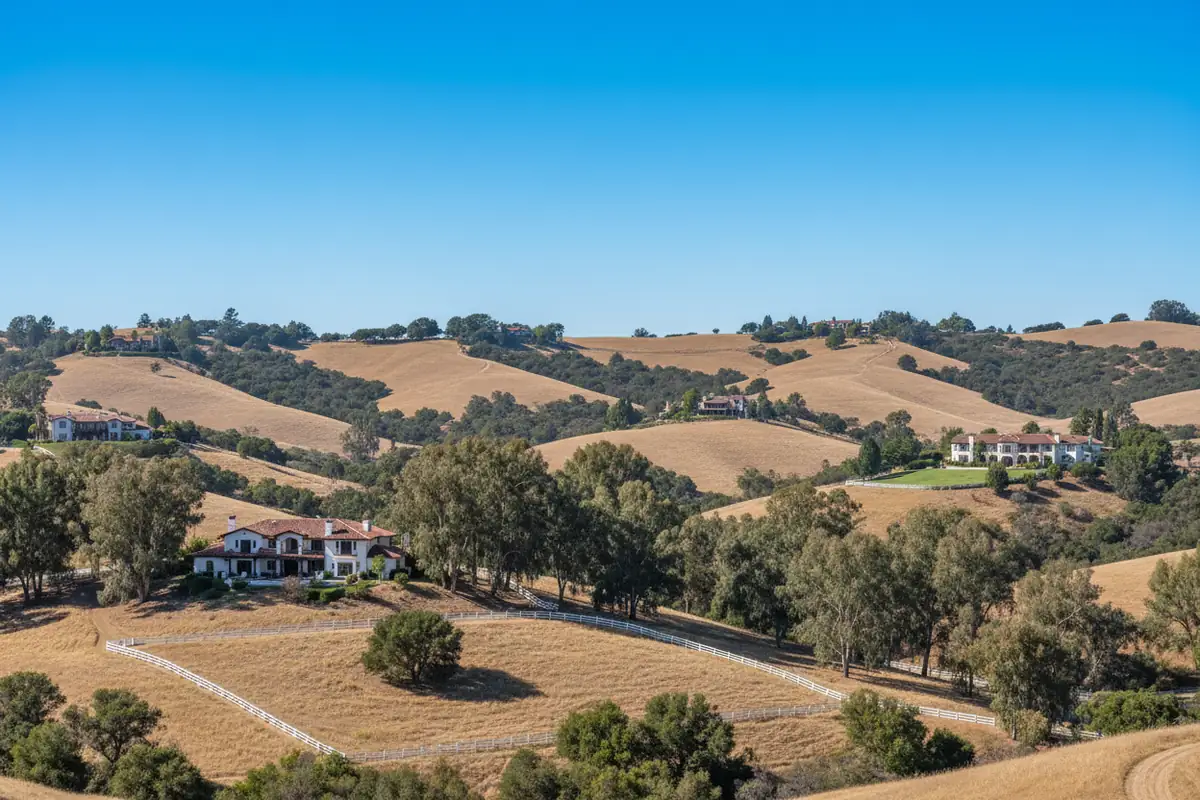
Family law cases from Rancho Santa Fe's ZIP codes, 92067 and 92091, are filed in the North County Division of the San Diego Superior Court, at 325 S. Melrose Drive in Vista. California's Family Code governs the case. Children in the Rancho Santa Fe School District share one K-8 campus, and Escondido Creek divides their high-school assignment.
Most people facing a separation in Rancho Santa Fe are carrying several questions at once: whether the family can stay in the house behind the Covenant gates for now, how the children's school year will hold together, and where any of this actually happens. Some live in Fairbanks Ranch, Whispering Palms, Elfin Forest or The Bridges and are not sure whether the same court and the same schools apply to them. This page lays out the local map, so that the legal steps that follow make sense in the place you live.
The Covenant, the Planning Area, and What "Unincorporated" Means for a Family Case
Rancho Santa Fe is an unincorporated community of San Diego County, not a city. There is no city hall, city council or city police department; most public services come from the County. That status explains why the agencies named later on this page are County and court agencies rather than municipal ones.
Much of the community's character comes from a private body. According to the County's San Dieguito Community Plan, "The Rancho Santa Fe Association, a homeowners association, was formed as a non-profit corporation on July 14, 1927." The Association adopted a Protective Covenant that uses deed restrictions, which are limits written into property deeds, to set building, land use and subdivision requirements. The Association also maintains facilities "for the sole benefit of its members, the property owners within the Covenant."
The same County plan describes the Covenant area as covering approximately 6,720 acres with approximately 1,900 residential building sites. It calls for lot sizes within the Covenant's Residential areas to be preserved at 2.86 acres and 2 acres. For a family case, those details matter in a plain way: a home inside the Covenant carries Association membership and deed restrictions along with it, and both stay attached to the property while spouses decide who will live there.
The Covenant is only part of the wider San Dieguito planning area. The County's plan lists that area's communities as including Rancho Santa Fe, Whispering Palms, Fairbanks Ranch, Elfin Forest, Del Dios, 4S Ranch, Rancho Cielo and The Bridges. Those names describe places in the plan; they do not by themselves decide which court division hears a case, which is set by ZIP code.
Where Rancho Santa Fe Family Cases Are Filed
The Superior Court of California, County of San Diego assigns family cases to a division by ZIP code. Its ZIP Code List (form ADM-254) shows "92067 RANCHO SANTA FE (POB) NORTH" and "92091 RANCHO SANTA FE NORTH." Both ZIP codes route to the North County Division, which sits at the North County Regional Center, 325 S. Melrose Drive, Vista, CA 92081. The court's list covers ZIP codes, not neighborhoods, so a household in Fairbanks Ranch or another San Dieguito community confirms its division by its own ZIP code on that list.
The division decides where filings, hearings and court services take place. It does not change the law. A divorce, legal separation, custody or support case heard in Vista is governed by the same California Family Code that applies anywhere in the state, and the court's own local rules sit on top of that code. Starting a case in the North County Division is therefore a question of location, not of a different rulebook.
Child Custody, Mediation, and Family Court Services
When a petition or other filing shows that custody, visitation or both are contested, Family Code section 3170 requires the court to set the contested issues for mediation. For parents in Rancho Santa Fe, that step is part of the case, not an optional extra.
In San Diego County that mediation is child custody recommending counseling with the court's Family Court Services, under Family Code sections 3170 and 3183. Under section 3183(a), the mediator, called a child custody recommending counselor, may, consistent with local court rules and except as section 3188 provides, make a recommendation to the court about custody or visitation, if it is first provided in writing to the parties and their attorneys, including counsel for any minor children, before the hearing. Family Court Services calls this person the Family Court Counselor. Family Court Services says that if no agreement is reached, the Family Court Counselor makes a recommendation to the court, and the court hearing proceeds. The counselor's recommendation carries weight, and the judge decides.
Section 3183 also allows the mediator, where parents have not reached agreement, to recommend that an investigation be conducted or that other services be offered before a hearing, and in appropriate cases to recommend restraining orders that protect the child while the dispute is pending.
Safety changes the process. Under Family Code section 3170(b), domestic violence cases are handled by Family Court Services in accordance with a separate written protocol approved by the Judicial Council. A parent who has experienced abuse is not placed in the same mediation format as everyone else.
The Rancho Santa Fe School District
For parents working out a parenting plan, the local school picture is unusually compact. According to the Rancho Santa Fe School District, "District enrollment is just over 600 students from the communities of Rancho Santa Fe, Elfin Forest, El Cielo, and The Bridges." The district's history page records that in 1971 "all nine grades (K-8) convened on one campus," and that "the current campus was completed in 2011."
One campus means that, in many families, both parents' homes feed the same school through eighth grade. That can simplify a parenting plan, since there is a single calendar and a single school community. It can also sharpen other questions: where a child is enrolled, which parent handles school communication, and how activities and add-on costs are shared are all issues parents may agree on or that a court may need to decide. A move out of the district by one parent can turn an easy arrangement into a contested one.
High School Boundaries: Torrey Pines, La Costa Canyon, and Open Enrollment
The single campus ends at eighth grade. The San Dieguito Union High School District's boundaries page states that "Torrey Pines High School shall include the boundaries of the Del Mar, Solana Beach and Rancho Santa Fe school districts, with the exception of the area north of Escondido Creek in the Rancho Santa Fe School District." La Costa Canyon High School includes "the area north of Escondido Creek in Rancho Santa Fe School District."
Two other campuses work differently. Canyon Crest Academy and San Dieguito High School Academy are open to a limited number of 9-12 grade students within district boundaries through an open enrollment application process approved by the district's Board of Trustees. The district also cautions that "Confirmation of attendance boundaries and enrollment eligibility can only be made by contacting the school directly."
This is where parents of middle-school children often begin thinking further ahead. If the parents live on different sides of the Escondido Creek line, or one parent moves across it, the assigned high school may differ by household. A parenting plan can address which address governs enrollment, how an open enrollment application will be handled, and how the parents will decide if they disagree. Settling those points before eighth grade tends to be easier than settling them in the spring of it.
Law Enforcement and Public Safety in Unincorporated Rancho Santa Fe
Because Rancho Santa Fe is unincorporated, law enforcement comes from the San Diego County Sheriff rather than a city police department. The City of Encinitas's Law Enforcement page states that the North Coastal Sheriff Station, located in Encinitas at 175 North El Camino Real, provides services for the unincorporated area of Rancho Santa Fe. The same page notes that requests for Sheriff's records, including incident reports, must be submitted directly to the San Diego County Sheriff's Office.
In family cases, that matters when there is a safety incident. A call to the Sheriff during a domestic violence incident can produce a report that later becomes relevant to a request for a protective order or to custody, and the records request goes to the Sheriff's Office, not to the Encinitas station or the court. On the family court side, as noted above, domestic violence cases are handled by Family Court Services under the separate protocol in section 3170(b).
California Family Law in Rancho Santa Fe: Property, Support, and the Six-Month Period
California is a community property state. Under Family Code section 2550, unless the spouses agree otherwise in writing or on the record in court, or the Family Code provides otherwise, the court divides the community estate equally. The community estate is, in plain terms, what the spouses acquired together during the marriage, along with the debts that go with it.
Timing rules shape the case from the start. Under Family Code section 2339, a judgment ending the marriage is not final until six months have passed from the date the respondent was served with the summons and petition, or the date the respondent appeared in the case, whichever occurs first; the court may extend that period for good cause. The clock does not start when the petition is filed.
Disclosure has a deadline too. Under Family Code section 2104(f), the petitioner serves a preliminary declaration of disclosure with the petition or within 60 days of filing it, and the respondent does the same with the response or within 60 days of filing it, unless the parties agree in writing or the court orders more time. When the petitioner serves the summons and petition by publication or posting under a court order and the respondent files a response before a default judgment is entered, the petitioner serves it within 30 days of the response being filed. That declaration, signed under penalty of perjury, identifies all assets and debts in which a spouse has or may have an interest, and it comes with an income and expense declaration, unless a current and valid one has already been provided, and all tax returns the spouse filed in the two years before serving it.
Values are not frozen at separation. Under Family Code section 2552, the court values assets and liabilities as near as practicable to the time of trial, and on 30 days' notice may for good cause use a date after separation and before trial. For a Covenant home, that means the value that matters is generally the value close to trial.
Where separate money went into a shared asset, Family Code section 2640 generally provides reimbursement. A spouse who traces a down payment, improvements or principal payments on community property to a separate-property source is reimbursed, without interest and capped at the property's net value, unless that spouse made a written waiver of the right to reimbursement or signed a writing that has the effect of a waiver. The opposite situation, community money paying down a loan on one spouse's separate-property home, is a different question, often called Moore/Marsden apportionment, and section 2640 does not govern it.
Access to counsel is addressed directly. Under Family Code section 2030, when one spouse requests fees, the court must make findings on whether there is a disparity in access to funds and whether one party can pay for both; if the findings show that disparity and ability to pay, the court orders fees and costs. In households where one spouse controlled the finances, this can be the order that lets both participate on even footing.
Working With the Firm on a Rancho Santa Fe Family Law Matter
Rancho Santa Fe Family Law Advocates practices California family law only. Its work centers on the questions this page describes: cases from Rancho Santa Fe ZIP codes filed in the North County Division at 325 S. Melrose Drive, Vista, CA 92081; custody matters that pass through Family Court Services; parenting plans built around a one-campus district and the Escondido Creek high-school line; and the Covenant home and the community estate while a case is pending. No outcome is promised in any matter; each turns on its own facts and the court's decision.
If You'd Like to Talk Through a Rancho Santa Fe Family Law Matter
A family case here touches several local systems at once: the Vista courthouse, Family Court Services, a Covenant property, and a school path that splits at Escondido Creek. A consultation is the place to sort through which of those pieces affect your situation, how the timing rules in sections 2339 and 2104 apply to your dates, and which questions about the home and the children are likely to need an agreement or a court order. To talk through how this applies to your family, contact Rancho Santa Fe Family Law Advocates to request a confidential consultation.
Frequently asked questions
Which court handles family law cases from Rancho Santa Fe?
Is mediation required in a Rancho Santa Fe custody case?
What does the Family Court Counselor do in a San Diego custody case?
How long does a divorce take in California?
Which high school do Rancho Santa Fe students attend?
What is the preliminary declaration of disclosure and when is it due?
How is community property valued in a California divorce?
Attorney Contributor: Amy J. Lass | California Bar No. 246779
Amy J. Lass contributes legal expertise and reviews selected legal content for accuracy. General information only — not legal advice.
- Published
- November 9, 2026
Sources
- California Family Code section 2030 — California Legislative Information
- California Family Code section 2104 — California Legislative Information
- California Family Code section 2339 — California Legislative Information
- California Family Code section 2550 — California Legislative Information
- California Family Code section 2552 — California Legislative Information
- California Family Code section 2640 — California Legislative Information
- California Family Code section 3170 — California Legislative Information
- California Family Code section 3183 — California Legislative Information
- ADM-254 Zip Code List (SDSC Form ADM-254, Rev. 1/25), Superior Court of California, County of San Diego — Superior Court of California, County of San Diego
- San Dieguito Community Plan, County of San Diego Planning & Development Services — sandiegocounty.gov
- Law Enforcement, City of Encinitas — encinitasca.gov
- District History, Rancho Santa Fe School District — rsfschool.net
- Boundaries Map, San Dieguito Union High School District — sduhsd.net
Questions About Your Case?
Divorce and custody questions rarely fit neatly into an article. Send us a message, and we'll listen to what's going on and help you understand your next steps.